A Field Guide to Structured Analytic Techniques (SATs)

Author's Note: This post is a personal exercise to structure my thoughts and build a cheatsheet. The topic is dry and I am not writing a traditional narrative. The goal is to internalise this primer and make it easier to understand. I recommend reading the official A Tradecraft Primer: Structured Analytic Techniques for Improving Intelligence Analysis document for more depth.
Moving Beyond Gut Instinct
I decided to write this because through my years conducting intelligence operations and analysis, I have realised that expertise can sometimes be a double-edged sword. I sometimes rely on mental models(constructs based on my past experiences) that lead me to ignore information that doesn't fit my expectations.
I recently started the ArcX Advanced CTI course. The materials recommend the US Government primer on Structured Analytic Techniques (SATs) which contained techniques to help analysts improve their thinking process. I spent the weekend reading it to try and internalise them.
Having a structured approach to analysis improves thinking. The primer groups these techniques into Diagnostic, Contrarian, and Imaginative.
Diagnostic Techniques
These methods help make your analytic arguments and assumptions clear for everyone to see. They explain the logic behind your judgements and help you find gaps in your information.
-
Key Assumptions Check: List the premises your judgements rest upon. This helps find logic errors early.
-
Quality of Information Check: Review your sources for mistakes or gaps. This prevents your analysis from anchoring to weak data.
-
Indicators or Signposts of Change: Track events or triggers to monitor targets and spot emerging trends.
-
Analysis of Competing Hypotheses (ACH): List all possible explanations. Tally inconsistencies to see which hypothesis is the weakest or strongest.
Contrarian Techniques
These tools explicitly challenge your current thinking and any dominant mindsets that might affect judgement. They protect you from making up your mind too early by forcing you to look at alternative explanations.
-
Devil’s Advocacy: Pick a specific view and try to prove it wrong. This exposes weak logic and hidden assumptions.
-
Team A / Team B: Use two teams to argue different sides of a major issue. This shows the merit in both views.
-
High-Impact / Low-Probability Analysis: Look at unlikely events that would cause massive problems.
-
What If? Analysis: Assume a surprise event has already happened. Work backward to see how it could have occurred.
Imaginative Thinking Techniques
These methods help you develop new viewpoints and imagine different ways a situation might end. They encourage creative thinking by allowing you to step outside your normal habits.
-
Brainstorming: Use a group to generate many ideas without judging them at first.
-
Outside-In Thinking: Look at large external forces like technology or politics that will shape a situation.
-
Red Team Analysis: Placing yourself in the shoes of your target. This stops you from assuming that they will act as you would.
-
Alternative Futures Analysis: Imagine several ways a complex situation might end. This uses uncertainty to map different possible scenarios.
Cognitive Bias Reference Table
These mental traps interfere with accurate perception.
| Bias | Definition | Operational Danger | Counter-Measure |
|---|---|---|---|
| Confirmation Bias | Seeking info that confirms your view. | You defend a wrong idea. | ACH. |
| Mirror Imaging | Assuming a target shares your values. | You fail to predict "irrational" actions. | Red Team Analysis |
| Anchoring | Focusing only on the first piece of info. | Assessments stay stuck to initial impressions. | Key Assumptions Check. |
| Availability | Judging probability by ease of recall. | You overestimate high-profile events. | Quality of Info Check. |
| Rationality | Viewing events as an orderly, rational pattern. | You reject the possibility of accident or error. | "What If?" Analysis. |
| Groupthink | Forcing consensus to minimise conflict. | Dissenting views are suppressed. | Devil's Advocacy. |
Summary of the Analytic Timeline
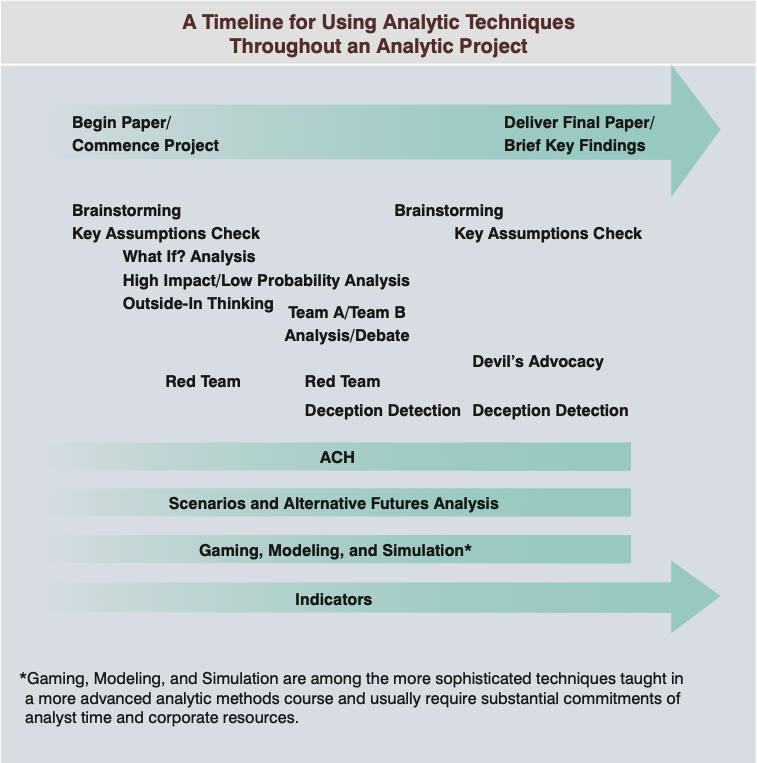
This timeline was extracted from the tradecraft primer.
- Project Kickoff: Start with Brainstorming, Key Assumptions Checks, and "What If?" Analysis to find factors you might take for granted or to explain how a surprise event could occur.
- Broadening Context: Use Outside-In Thinking early to place the project into a broader international context.
- Sensitivity Assessment: Perform a High-Impact/Low-Probability Analysis to sensitise yourself to the potential impact of unlikely events that would have major consequences
- Hypothesis Testing: As hypotheses form, use Red Team analysis to correct for "rational actor" bias or Team A/Team B debates to clarify competing mindsets.
- Final Quality Check: Before delivery, use Devil’s Advocacy to challenge a firm consensus or perform a final review of assumptions as a logic check.
- Continuous Tools: Indicators and Analysis of Competing Hypotheses (ACH) should be used throughout the project as new information is absorbed and analysed.
Conclusion
SATs are necessary for professional rigour. Experts are more prone to such biases due to their past success with specific mental models. We tend to perceive what we expect to see. And we often resist change even when new evidence appears. These techniques ensure that our analysis is objective, transparent and our judgements remain credible.